
24 Engine Lease economics your client can trust.
Model, compare, and explain every occupancy-cost assumption from one auditable engine.
Why this exists
Brokers don't lose time because lease math is impossible. They lose it because every proposal becomes another spreadsheet version, every concession changes the story, and the client still asks why one NER doesn't match another. 24 Engine keeps the model, assumptions, and deliverables in one auditable place.
Capabilities built for the conversation, not just the calc.
Every number that lands in a client deck is traceable to its assumption. Every scenario is comparable on the same axes. Every export is the same engine.
Three NER conventions, calculated in parallel
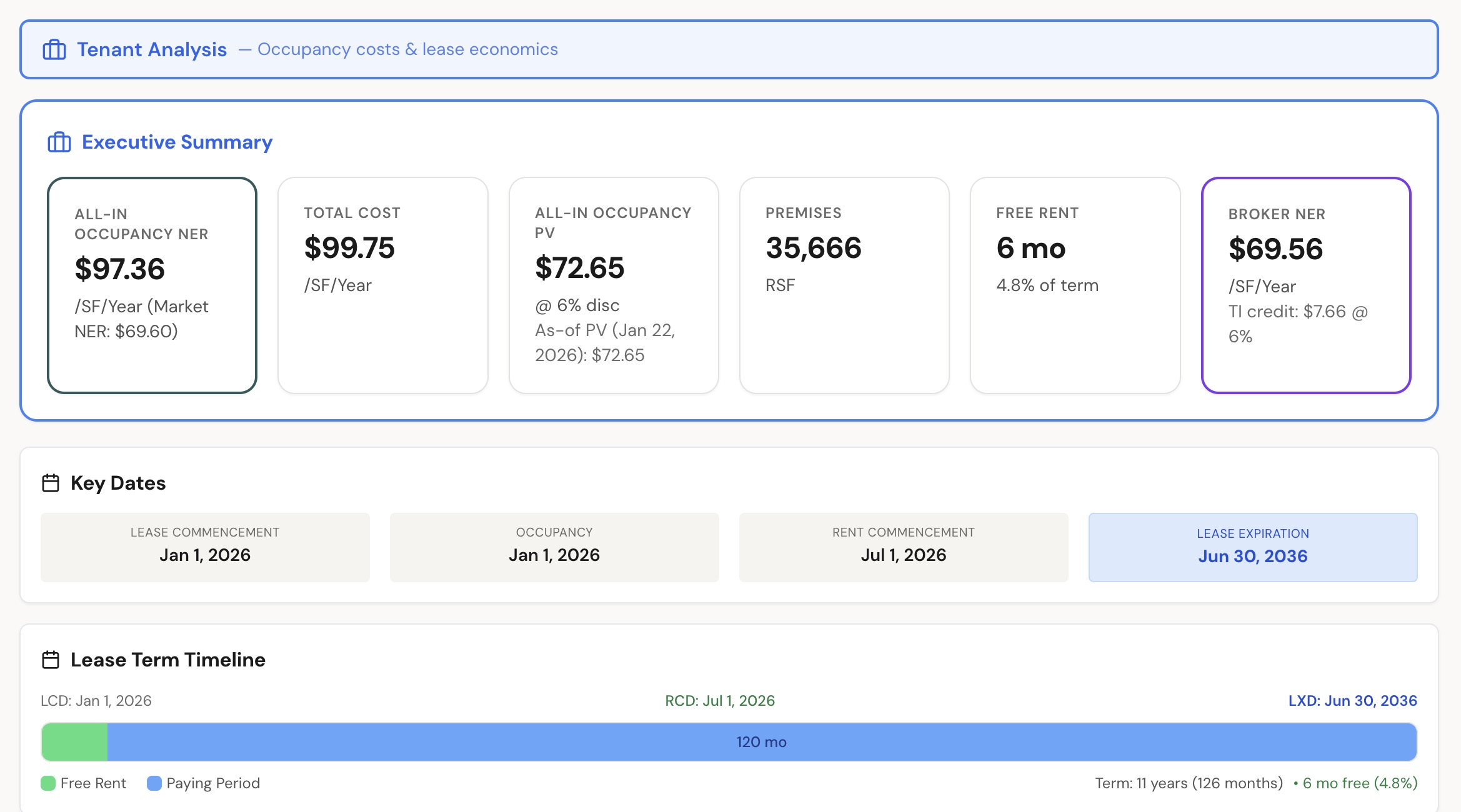
PV-Discounted Broker NER, institutional NER, and all-in occupancy NER are produced separately so deal-comparison, landlord, and CFO conversations don't blur into a single misleading number. Switch views without re-running the model.
Month-by-month cash flow engine
Base rent, free rent, TI, escalations, utilities, incentives, taxes, and dated adjustments roll through monthly cash flows. No annual shortcut math. Works whether the deal commences mid-month or mid-quarter.
Market-specific tax and incentive handling
NYC CRT, DOF, PLUTO, ICAP, REAP, and Porter's Wage live alongside Chicago PIN and Cook County tax logic. Real parcel data, not a flat percentage estimate.
Side-by-side scenario comparison
Compare two, three, or six scenarios on NER, PV, free rent value, TI, escalations, total occupancy cost, and ASC 842 schedules. The comparison view is what brokers actually send to clients.
PDF extraction and lease intake
Upload a proposal PDF and the deal points populate a scenario in seconds. Edit, override, and re-run without retyping numbers from a real estate brokerage's flier.
Client-ready artifacts from one source
PDF reports, Excel workbooks, shareable read-only links, sensitivity tables, and GAAP straight-line schedules generate from the same scenario. No reconciling versions across files.
Built for everyone in the lease conversation.
Tenant-rep brokers, landlord teams, sublandlord teams, and tenant CFOs all work from the same model. No one is rebuilding someone else's spreadsheet.
Compare proposals you can defend
Walk a client through how free rent, TI, tax, and escalation clauses move the answer. Show the math, not just the conclusion. Replace the deal-specific Excel that breaks every time concessions change.
Review without rebuilding
Open the broker's scenario, see PV, all-in occupancy cost, and ASC 842 straight-line schedules without rebuilding their model. Override assumptions, sign off, or kick back.
Underwrite from the other side
Income, downtime carry, recovery, spread, and net disposition economics in the same engine the tenant side is using. Negotiate on shared math.
Markets
Glossary
The vocabulary the product expects you to know — and the vocabulary the product actually models.
A per-square-foot summary of lease economics, net of concessions like free rent and TI. NER conventions vary across brokers, landlords, and CFOs — there is no single industry definition. 24 Engine computes three in parallel: PV-Discounted Broker NER (annuitized rent stream at the NER discount rate, minus amortized TI), institutional NER (present-value-weighted market-comp metric), and all-in occupancy NER (folds in OpEx, real estate tax, utilities, and other pass-throughs).
The discounted value of future lease cash flows. Used to compare deals with different terms, escalations, and concession timing on equal footing. 24 Engine discounts monthly, not annually.
The unit of comparison in commercial leasing. Rent, NER, occupancy cost, and operating expenses are all expressed PSF so deals of different sizes can be compared.
Landlord-funded buildout allowance, expressed as a dollar amount or PSF. TI is a concession that materially moves NER and PV; treating it as an above-the-line credit versus an amortized cost changes the answer.
The annual increase applied to base rent. Fixed (e.g. 3% per year), CPI-linked, or stepped to a stated PSF. Compounding matters — a 3% annual bump over 10 years adds 30% in cumulative dollars, not 30 PSF.
Base rent plus operating expenses, real estate taxes, utilities, and any other tenant-paid charges. The number a CFO actually budgets against. Always higher than face rent.
The GAAP lease accounting standard. 24 Engine produces a straight-line expense schedule and deferred rent impact per scenario, suitable for review and reconciliation alongside your accounting system. Full ROU asset and lease liability rollforwards are on the roadmap.
Months at the start of the term where no base rent is due. Often the largest single concession in a deal. Modeled as a discrete cash-flow gap, not a blended PSF reduction.
Frequently asked questions
If something here isn't answered, write to support@24engine.com or open the app and try a sample deal.
How is Net Effective Rent calculated in 24 Engine?
Does 24 Engine replace Argus?
Which markets does 24 Engine support today?
My deals aren't in NYC or Chicago. Can I still use it?
Can I import a lease proposal PDF?
Does 24 Engine support ASC 842 lease accounting?
Can I share a deal with my client without giving them a seat?
How is this different from a spreadsheet?
Is the data secure?
Request access for your team.
24 Engine is currently in a curated beta for real estate teams evaluating lease analysis workflows.